Agentic Code Evaluation and Tagged Multi-Asset Rendering in AI Video Production
AI filmmakers are combining code-driven agentic motion graphics with indexed asset reference sheets. By leveraging Claude Fable 5.2 inside Remotion to self-evaluate visual code outputs, and tagging multi-view character sheets inside Seedance 2.5, creators can automate graphical adjustments and prevent visual drift across commercial cuts.
 FRMWRKD-EXPLAINED
 Youri van Hofwegen
Top learnings
Deploying parallel, single-purpose AI agents with frame self-evaluation automates motion graphics refinement in Remotion while reducing manual revision overhead.
Indexing distinct asset references in video models using explicit tag numbers prevents character morphing and preserves branding details across multi-shot cuts.
Avoiding maximum effort model generation settings prevents a three-fold increase in token expenditure while yielding superior code and design execution.
How do agentic code loops and indexed asset binding change AI video workflows?
AI filmmaking workflows are shifting from open-ended text prompting toward structured code execution and multi-reference asset binding. Rather than relying on single-pass video generation models to handle complex typography, motion graphics, and character continuity simultaneously, creators are separating motion graphics code from character video rendering.
Creator testing demonstrates that Anthropic's Claude Fable 5.2 model enables code-driven video tools like Remotion to assemble and refine data-driven motion graphics programmatically. Simultaneously, video generation engines like Seedance 2.5 now allow filmmakers to bind up to five indexed image references within a single prompt, ensuring character, prop, and location consistency across long-form multi-shot sequences.

Read source excerpts 2
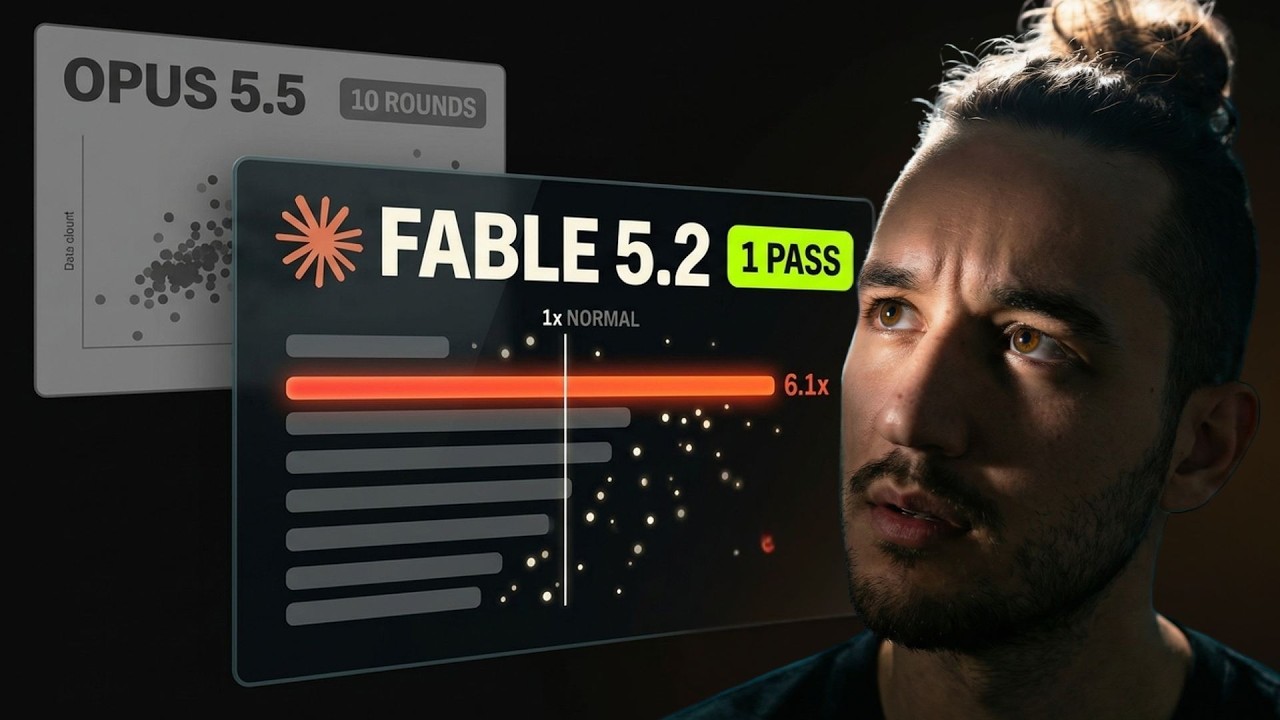
it. Same data, same timing, only the model changed. Here is every difference. Fable 5.2 is Anthropic's newest model. On their own tests, it scores higher than Opus 5.5 in
FRMWRKD-EXPLAINED
take all five of them in a single generation, but only if the prompt tells it exactly which image is which. So, back in video, I'll pick seedance 2.5 again. Keep it on 30
Youri van Hofwegen
How do creators implement agentic code evaluation and headless asset conditioning?
Creators differ in how they execute asset control across programmatic and diffusion-based workflows. In code-driven motion graphics, a multi-agent system deploys isolated Claude Fable 5.2 instances to modify React code for Remotion animations. Each agent receives source data and code, renders video frames locally, inspects the visual output, and fixes layout errors autonomously before finalizing the shot.
In diffusion-based video production, creator Youri van Hofwegen addresses character drift by generating multi-angle reference sheets in GPT Image 2.5 sunburst. To prevent facial distortion, van Hofwegen deliberately crops the front turnaround panel at the neck to create a headless body, forcing Seedance 2.5 to extract facial features exclusively from an adjacent high-resolution portrait close-up while referencing separate logo, location, and prop sheets.
Read source excerpts 2
Each agent got the existing code and the same data. Three, every agent rendered its own frames, looked at them, and fixed what was wrong before it reported back. On the left,
FRMWRKD-EXPLAINED
notice the front panel has no head, and that's on purpose. So, the model only takes the face from the close-up, and it doesn't change halfway through the video. The whole
Youri van Hofwegen
What step-by-step pipeline connects tagged asset references and code agents?
Filmmakers can combine code-based graphic automation with tagged reference video rendering into a unified post-production pipeline. First, generate baseline asset sheets—including headless body turnarounds, facial close-ups, and product references—against flat gray backgrounds in image models like GPT Image 2.5 sunburst.
Next, upload up to five reference sheets into Seedance 2.5, establishing a strict numerical index from image one to image five. Write multi-shot prompts that explicitly assign indexed assets to specific scenes, such as instructing the model to pull character faces and wardrobe from designated tags during interaction shots.
Finally, for kinetic titles, lower thirds, or analytical charts, run parallel Fable 5.2 agents to write and compile Remotion code, allowing each agent to evaluate rendered frames self-sufficiently before exporting final motion graphics overlay tracks.
ReelStack suggests adopting this dual pipeline for commercial spot campaigns where branded UI text and data graphics demand exact mathematical layout while narrative scenes require locked character identities.
Read source excerpts 2
the order really matters here since that's what decides their numbers. So the logo is at image one, the bottle sheet is at image two, Rosa is at image three, Braum is at image
Youri van Hofwegen
is the score. This is how the work was set up. One, not one agent for the whole video. One agent per animation all at the same time. Two, nothing was built again from scratch.
FRMWRKD-EXPLAINED
What are the token cost limits, effort settings, and spatial drift failure points?
Despite the precision of agentic code execution and indexed reference rendering, directors must manage distinct operational boundaries. In code generation, Anthropic's benchmark data reveals that configuring Fable 5.2 to maximum effort settings increases token costs roughly threefold while yielding lower performance scores than standard high-effort configurations. Fable 5.2 costs $8 per million input tokens and $40 per million output tokens, making unnecessary token consumption expensive across multi-agent loops.
In diffusion generation, multi-asset indexing does not completely eliminate spatial tracking failures. In fast-paced sequence tests, characters referencing attached asset sheets can inadvertently swap physical positions or trade props during sudden camera lifts or complex multi-subject interactions, requiring manual shot trimming or keyframe adjustments in non-linear editing software.
Read source excerpts 2
picture. One more thing about cost. More effort is not always better. On Anthropic's coding chart, the highest effort setting costs about three times more than the one below
FRMWRKD-EXPLAINED
they get lifted up, however, the characters switch places, which is small, but worth noting. So, with the tools in my bonus package, you can speed up your AI creation process
Youri van Hofwegen
Key moments to explore
Optional deep divesWant to see a technique in action? Jump into the source videos. These AI-extracted timestamps may be approximate.
- 01:50 ↗Claude Fable 5.2 outperforms Opus 5.5 on Anthropic's code benchmarks while offering a lower price-to-performance ratio.FRMWRKD-EXPLAINED · Claude Fable 5.2 - even better than Opus 5.5
- 01:08 ↗Seedance 2.5 supports generating full 30-second realistic video clips with dialogue from a single multi-shot prompt, with a draft mode at 480p available to test prompts before spending credits.Youri van Hofwegen · How to Make Your First AI Video with Higgsfield AI!
- 03:20 ↗Remotion allows AI models to render and alter video directly through React code modifications rather than manual drawing.FRMWRKD-EXPLAINED · Claude Fable 5.2 - even better than Opus 5.5
- 03:12 ↗Juan 3.0 Prime excels at stylized anime and fast-action scenes while maintaining visual coherence across rapid movement and explosions.Youri van Hofwegen · How to Make Your First AI Video with Higgsfield AI!
Put it into practice
Get the practical weekly briefing →The useful ideas in one email. Subscribe to keep learning. Need a filmmaker for your project? →Tell us what you want to make and submit a project brief.Go to the source
2 videos