Biomechanical Motion Skills, Material Texture Layering, and Strategic Model Routing
AI directors are refining VFX pipelines by combining real material texture inputs, custom Claude motion skills, and targeted visual markup. When paired with multi-model budget routing across engines like Wan 3.0, Kling 4.0, and Seedance 2.5, creators can achieve realistic weight and surface detail while managing render costs.
 AI Search

Top learnings
Layering real-world material photos onto draft creature designs improves surface fidelity before initiating video diffusion renders.
Codifying movement rules into LLM motion skills prevents weightless character motion by explicitly dictating mass transfer and foot contact.
Routing dialogue scenes to low-cost engines like Wan 3.0 while reserving Seedance 2.5 for complex relighting reduces overall rendering spend.
How do material texture transfers and custom motion skills fix visual drift?
Generating believable creatures and visual effects in AI video often fails due to synthetic surface textures and floaty, weightless physics. To solve surface artifacts, creator Higgsfield demonstrates passing high-resolution photographs of real materials—such as genuine bird feathers or animal skin textures—into Claude alongside a base creature design. Instructing the language model to extract micro-textures while preserving the underlying silhouette produces realistic surface detail for downstream video engines.
To address physical movement errors, creators construct custom motion skills inside Claude that codify biomechanical rules. By defining how mass shifts when a foot strikes the ground, how the torso settles under load, and how appendages counterbalance motion, the language model outputs structured video prompts that enforce realistic momentum. Concurrently, technical developments like UniAction allow conditioning video diffusion directly on discrete action vectors and physical force parameters, shifting control from text guesswork to mechanical rules.

Read source excerpts 2
more believable detail.</font> <font color="#FFFFFF">I tell Claude what to take from each reference:</font> <font color="#FFFFFF">feather detail from this image,</font> <font
Higgsfield AI
have a new AI called Uni Action. This takes an image, a text prompt, and action controls, and then generates a video that follows those actions. So, here are some examples for
AI Search
How should directors route multi-model renders across budget and flagship engines?
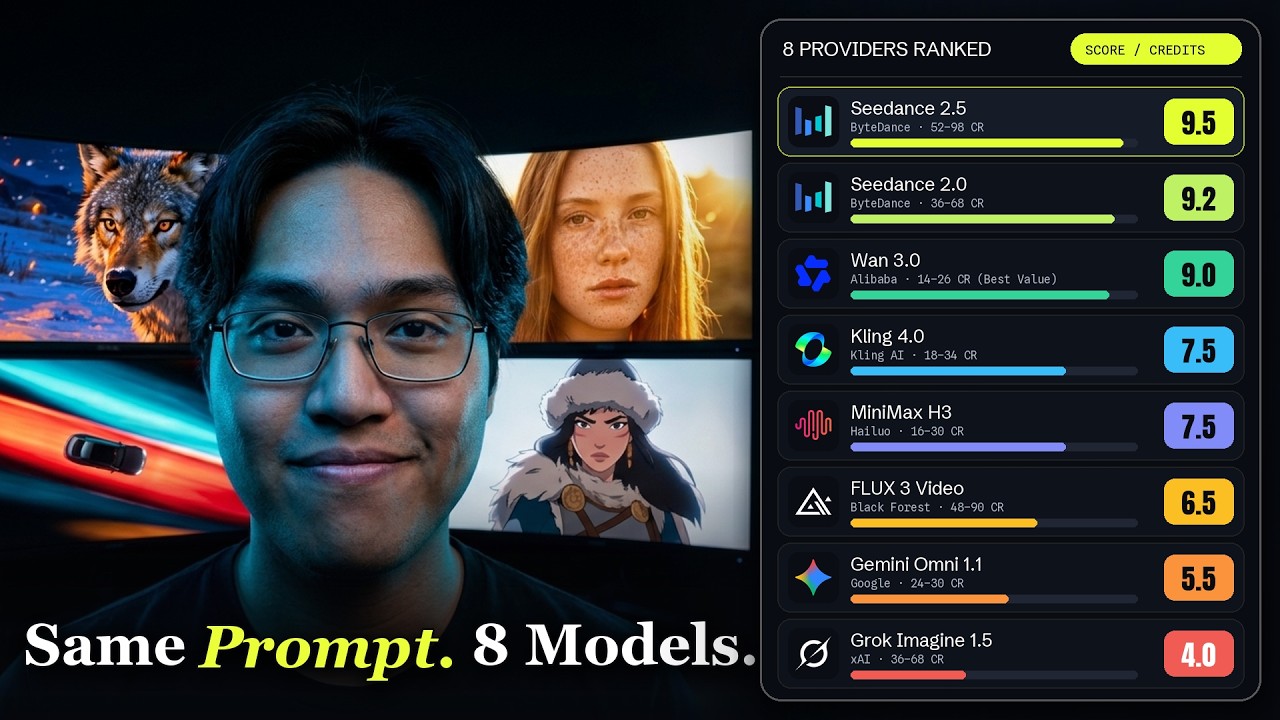
Filmmakers facing limited production budgets must balance render costs against specific shot requirements rather than relying on a single flagship model. Systematic benchmarking across eight top video engines reveals clear functional specialization. For quiet, dialogue-driven dramatic close-ups, Wan 3.0 delivers natural facial micro-expressions and convincing emotional cadence at a fraction of the cost of flagship models.
Conversely, dynamic scene requirements call for alternate engine choices. Kling 4.0 excels at sweeping, dynamic camera moves during multi-subject action and dance choreography, outperforming competitors in movement tracking despite generating synthetic audio. For high-end automotive commercials or complex environmental reflections where lighting interaction is paramount, Seedance 2.5 remains necessary to prevent surface artifacts and geometry distortion.
 FRMWRKD-EXPLAINED
Read source excerpts 2
going to be a 7.5 for me. So, next is 1 3.0 using 26.25 credits. I guess the only thing that I will notice here is that it looks very flat, but honestly, the emotions and how
FRMWRKD-EXPLAINED
Likeness of characters very consistent. I'll probably also just give this one a seven out of 10, honestly. I actually like Kling 4.0 compared to SeaDance only because [music]
FRMWRKD-EXPLAINED
What step-by-step pipeline connects 180-degree plates, visual markup, and motion skills?
Filmmakers can execute complex character and creature swaps inside existing footage through a structured pre-production handoff. First, record a 180-degree video turnaround of the actor under even lighting to serve as a persistent identity element. Next, prepare the source plate by applying a Gaussian blur to the original actor's head, preventing the video diffusion model from blending facial features during generation.
To place secondary elements or direct motion paths accurately, draw simple spatial guides directly onto a frame capture—such as marking target standing positions or focal directions with basic colored shapes. Pass the modified guide frame, the blurred source plate, the 180-degree identity reference, and active motion skills to Claude to construct the final video prompt. Render the shot in an engine like Seedance 2.5, using tag mentions to link references cleanly without re-uploading assets.
 Higgsfield AI
Read source excerpts 2
yourself,</font> <font color="#FFFFFF">record a short 180-degree video of yourself turning slowly,</font> <font color="#FFFFFF">so the model can see you from different
Higgsfield AI
face, I ask Claude to blur Erik's head in the source clip and keep my video</font> <font color="#FFFFFF">as the identity reference. Then I update the inputs and ask Claude for
Higgsfield AI
What operational trade-offs and physical limitations restrict AI creature integration?
Despite improvements in texturing and motion guidance, directors must navigate clear technical bottlenecks. Custom motion skills in Claude improve momentum description, but they rely on textual inference rather than true physical simulation; complex physical stunts still require multiple generation passes or practical motion references. Furthermore, while budget models like Wan 3.0 cut credit spend drastically, they produce flat lighting and poor native audio, requiring secondary sound design and color grading in post-production.
Additionally, emerging 3D extraction tools present format limitations for traditional pipelines. Lightweight generators such as IDOL render 3D Gaussian splats—cloud point representations—rather than standard polygonal 3D meshes with clean UV maps. While these splats enable rapid single-image spatial visualization, they cannot be directly rigged or edited using standard non-linear post-production pipelines without specialized rendering workflows.
Read source excerpts 2
gives away the AI likeness of it. So, this is going to go at a seven out of 10. And our last model is one at 14 credits, still the cheapest one. So, the audio is very bad.
FRMWRKD-EXPLAINED
missing parts that are not visible very well. Now, this is not a traditional 3D mesh, but instead it uses gausian splatting. So, think of this as like a ton of dots scattered
AI Search
Key moments to explore
Optional deep divesWant to see a technique in action? Jump into the source videos. These AI-extracted timestamps may be approximate.
- 01:23 ↗Generating character sheets in Claude via Higgsfield MCP allows creators to quickly test creature motion across multiple image models prior to full generation.Higgsfield AI · Can AI Beat $10,000 VFX Artist?
- 01:14 ↗MotionBricks generates real-time, smooth character and humanoid robot motion transitions inside Unreal Engine from target poses and movement instructions.AI Search · AI finally sleeps, Gemini 4 Carbon, ETH cracked, energy-based models, Anthropic IPO: AI NEWS
- 0:34 ↗Video models are benchmarked across five specific metrics: prompt accuracy, natural motion, integrated audio, cross-shot consistency, and avoidance of AI artifacts.FRMWRKD-EXPLAINED · I Gave 8 AI Video Models the Same Prompt. Here's Every Result
- 02:05 ↗Supplying real material texture references (feathers and skin) to Claude improves creature surface detail for video models.Higgsfield AI · Can AI Beat $10,000 VFX Artist?
- 02:05 ↗MotionBricks runs at up to 15,000 frames per second with 2ms latency using two open-source 800 MB models trained on over 350,000 motion clips.AI Search · AI finally sleeps, Gemini 4 Carbon, ETH cracked, energy-based models, Anthropic IPO: AI NEWS
- 1:13 ↗In stylized Arcane-like painterly animation tests, Seedance 2.0 and Seedance 2.5 outperformed competitor models in emotion and costume detail.FRMWRKD-EXPLAINED · I Gave 8 AI Video Models the Same Prompt. Here's Every Result
Put it into practice
Turn an AI film brief into a shot plan →Practical steps and checks before committing to production. Get the practical weekly briefing →The useful ideas in one email. Subscribe to keep learning. Need a filmmaker for your project? →Tell us what you want to make and submit a project brief.Go to the source
3 videos