Claude Fable 5.2 - even better than Opus 5.5
Provides actionable guidance for AI creators on deploying Anthropic's Claude Fable 5.2 in multi-agent workflows to programmatically generate and refine motion graphics code.
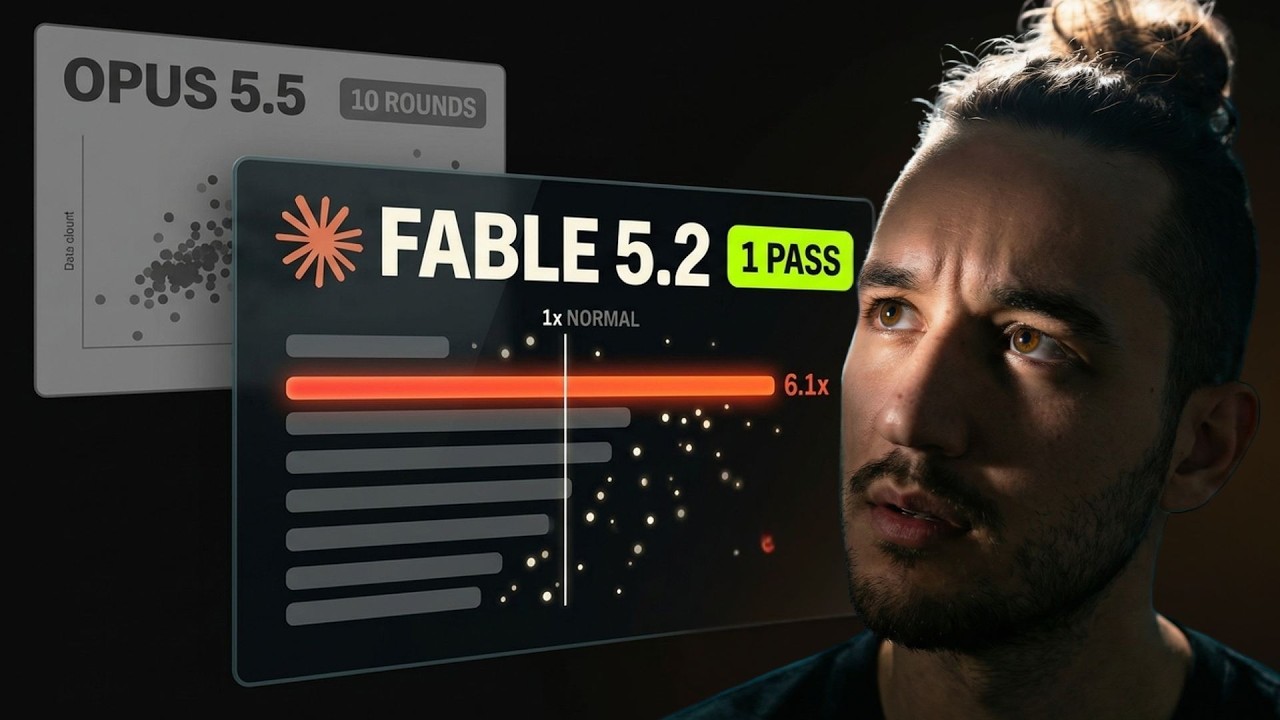
What this lesson covers
The video benchmarks Claude Fable 5.2 against Opus 5.5 across five code-driven motion graphics tests generated using Remotion and YouTube channel analytics data. It highlights Fable 5.2's improvements in visual layout design, rendering speed, token cost efficiency, and agentic multi-pass frame evaluation.
Key takeaways from the creator
AI-extracted notes, not independently verified product claims. Timestamp links let you check each point in the original video.
- 01:50 ↗
Claude Fable 5.2 outperforms Opus 5.5 on Anthropic's code benchmarks while offering a lower price-to-performance ratio.
- 03:20 ↗
Remotion allows AI models to render and alter video directly through React code modifications rather than manual drawing.
- 04:48 ↗
Fable 5.2 costs $8 per million input tokens and $40 per million output tokens, outputting code up to 30% faster than Fable 5.1.
- 06:07 ↗
High-effort model generation settings can cost up to three times more than standard settings without delivering proportional quality improvements.
- 07:08 ↗
Running parallel single-purpose AI agents that render frames, evaluate outputs, and fix code self-sufficiently optimizes multi-shot motion graphics production.
Workflow outlined in the video
- Assign single dedicated AI agents to individual animation components rather than running one continuous script across an entire video project.
- Supply existing codebases and exact data files to the LLM agent to refine layouts instead of prompting it to build from scratch.
- Implement a self-correcting agent feedback loop where the model renders output frames, inspects the visual results, and patches code errors before finalizing.
- Select moderate effort settings during model inference to optimize output quality against token generation costs.
Before you use this workflow
These notes describe the source video at its publication date. Model access, pricing, connectors and interfaces may have changed. Check the original source and the provider’s current documentation before installing an add-on, connecting an account or spending credits.
ReelStack has not independently tested this workflow. Preview one representative shot and check motion, continuity and output quality before applying it to a full production. No result, cost saving or model capability is guaranteed.
Explore the tools
How to interpret the numbers
2,373 views captured 12 November 2026. ReelStack recommendation score: 56/100. Formula: radar-v5. This is ReelStack’s calculation, not a YouTube rating or a measure of factual accuracy.
Show the calculation
- 45% performance: 3.46× views vs 9 other channel videos observed at a similar age. View-evidence factor 70% (views / (views + 1,000))
- 25% freshness: 89/100 with a 14-day half-life
- 20% momentum: 133 views/day vs 130 channel baseline (9 comparable uploads), with the same view-evidence factor
- 10% engagement: 20/100; likes + 4× comments, smoothed with a 500-view neutral prior