They solved AI’s memory problem!
Understanding foundational LLM memory architectures helps AI filmmakers grasp how next-generation text models and underlying agents manage long-form narrative context and prompt execution.
What this lesson covers
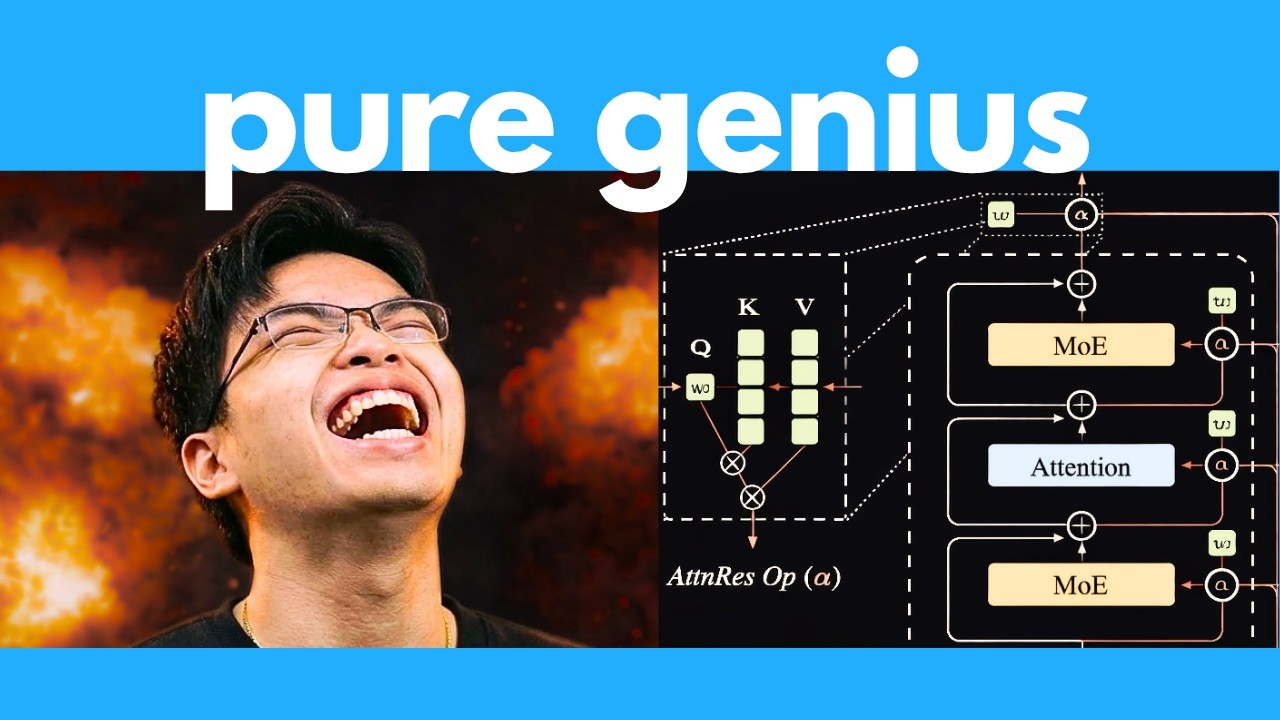
This video breaks down a recent AI research paper from Kimi AI introducing 'attention residuals' to solve the amnesia problem in deep language models. It explains how traditional residual connections can accumulate noise and degrade context in massive networks, proposing a new architectural approach.
Key takeaways from the creator
AI-extracted notes, not independently verified product claims. Timestamp links let you check each point in the original video.
- 00:11 ↗
Current trillion-parameter AI models suffer from an 'amnesia' problem where their working memory maxes out during complex multi-step reasoning.
- 03:19 ↗
Traditional residual connections act as shortcuts for information, allowing networks to scale to hundreds of layers by preventing the vanishing gradient problem.
- 03:54 ↗
Accumulating layer outputs in standard residual networks creates a massive cumulative pile of data, burying early information and reducing retrieval accuracy.
Workflow outlined in the video
- Review the original Attention Residuals research paper to understand the mathematical adjustments proposed for deep networks.
- Consider how context length limitations affect complex, multi-prompt scriptwriting workflows with large language models.
Before you use this workflow
These notes describe the source video at its publication date. Model access, pricing, connectors and interfaces may have changed. Check the original source and the provider’s current documentation before installing an add-on, connecting an account or spending credits.
ReelStack has not independently tested this workflow. Preview one representative shot and check motion, continuity and output quality before applying it to a full production. No result, cost saving or model capability is guaranteed.
How to interpret the numbers
307,407 views captured 23 October 2026. ReelStack recommendation score: 58/100. Formula: radar-v5. This is ReelStack’s calculation, not a YouTube rating or a measure of factual accuracy.
Show the calculation
- 45% performance: 2.55× views vs 10 other channel videos observed at a similar age. View-evidence factor 100% (views / (views + 1,000))
- 25% freshness: 0/100 with a 14-day half-life
- 20% momentum: 36 views/day vs 6 channel baseline (5 comparable uploads), with the same view-evidence factor
- 10% engagement: 89/100; likes + 4× comments, smoothed with a 500-view neutral prior