Seedance 2.5 vs MiniMax H3 vs WAN 3.0 (Who WINS?)
Provides practical blind test evaluations comparing Seedance 2.5, MiniMax H3, and Wan 3.0 across essential AI filmmaking requirements including dynamic camera tracking, dialogue delivery, fluid physics, and reference retention.
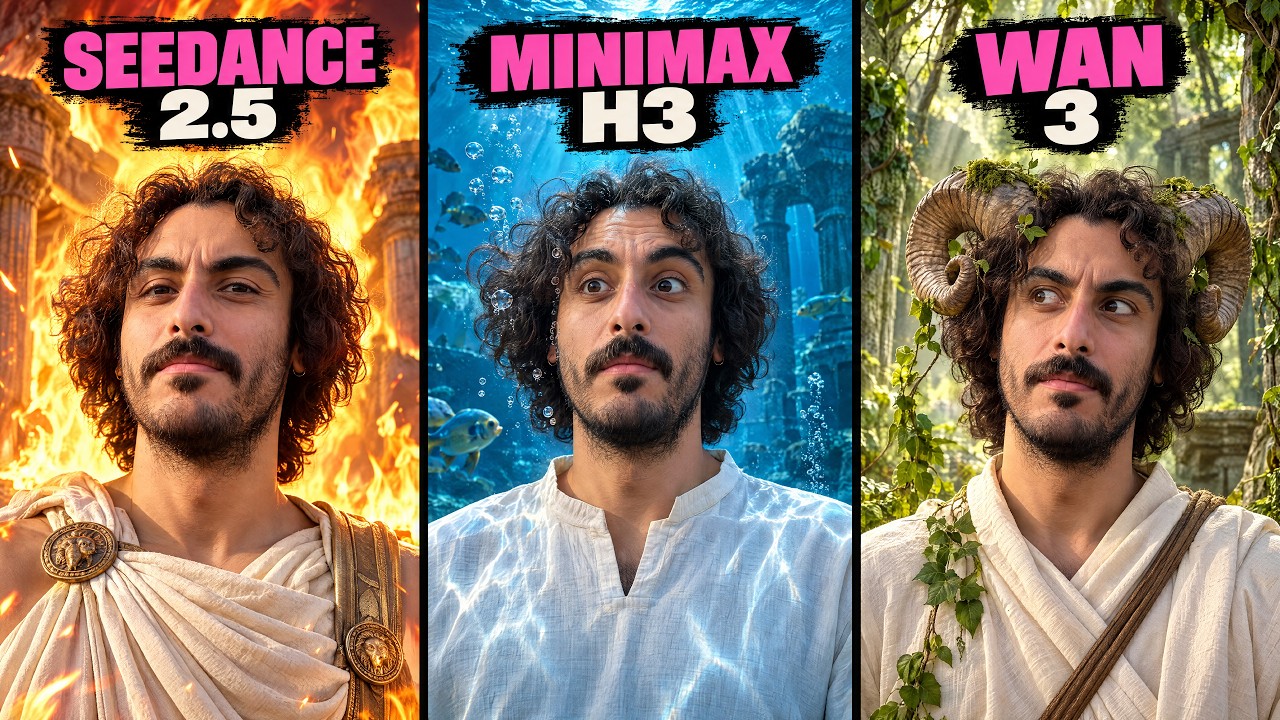
What this lesson covers
CyberJungle evaluates Seedance 2.5, MiniMax H3, and Wan 3.0 through blind benchmark tests using identical prompts and reference inputs across creative stress tests. The comparison analyzes dynamic camera motion, dialogue lip sync, fluid physics, and character consistency to help filmmakers select the best video generator.
Key takeaways from the creator
AI-extracted notes, not independently verified product claims. Timestamp links let you check each point in the original video.
- 00:59 ↗
Seedance 2.5 demonstrates stronger camera motion handling and dynamic smoothness during action sequences compared to MiniMax H3 and Wan 3.0.
- 04:10 ↗
MiniMax H3 delivers more natural dialogue lip sync and believable facial performance than Seedance 2.5 and Wan 3.0 in conversational clips.
- 06:04 ↗
Seedance 2.5 handles body physics, weight, and momentum effectively, whereas MiniMax H3 shows strength in liquid fluid dynamics.
- 09:05 ↗
Multi-reference consistency retention varies between models, with Seedance 2.5 holding visual references and background continuity better under high reference counts.
Workflow outlined in the video
- Run blind benchmark tests using identical prompts and reference assets across candidate AI video models to assess relative strengths objectively.
- Test dynamic camera movement prompts to evaluate framing smoothness and check for unwanted cuts or static rendering.
- Assess dialogue delivery by reviewing facial micro-expressions, pacing, and lip-sync alignment against identical audio scripts.
- Stress-test physical realism using prompts involving fluid dynamics, weight transfer, and object collisions.
- Input multiple reference images into AI chatbot workflows to verify character and environment consistency across sequential shots.
Before you use this workflow
These notes describe the source video at its publication date. Model access, pricing, connectors and interfaces may have changed. Check the original source and the provider’s current documentation before installing an add-on, connecting an account or spending credits.
ReelStack has not independently tested this workflow. Preview one representative shot and check motion, continuity and output quality before applying it to a full production. No result, cost saving or model capability is guaranteed.
How to interpret the numbers
5,762 views captured 19 September 2026. ReelStack recommendation score: 47/100. Formula: radar-v5. This is ReelStack’s calculation, not a YouTube rating or a measure of factual accuracy.
Show the calculation
- 65% performance: 0.53× current views vs the channel's recent median; same-age history is not yet available. View-evidence factor 85% (views / (views + 1,000))
- 25% freshness: 92/100 with a 14-day half-life
- Momentum pending: collecting daily snapshots; its 20% weight goes to observed performance, not free points
- 10% engagement: 43/100; likes + 4× comments, smoothed with a 500-view neutral prior