Prompt Like THIS to Master Making AI Videos (5 Levels)
Mastering structured prompting parameters gives AI filmmakers granular control over camera behavior, atmospheric lighting, and action pacing without relying on trial-and-error generation.
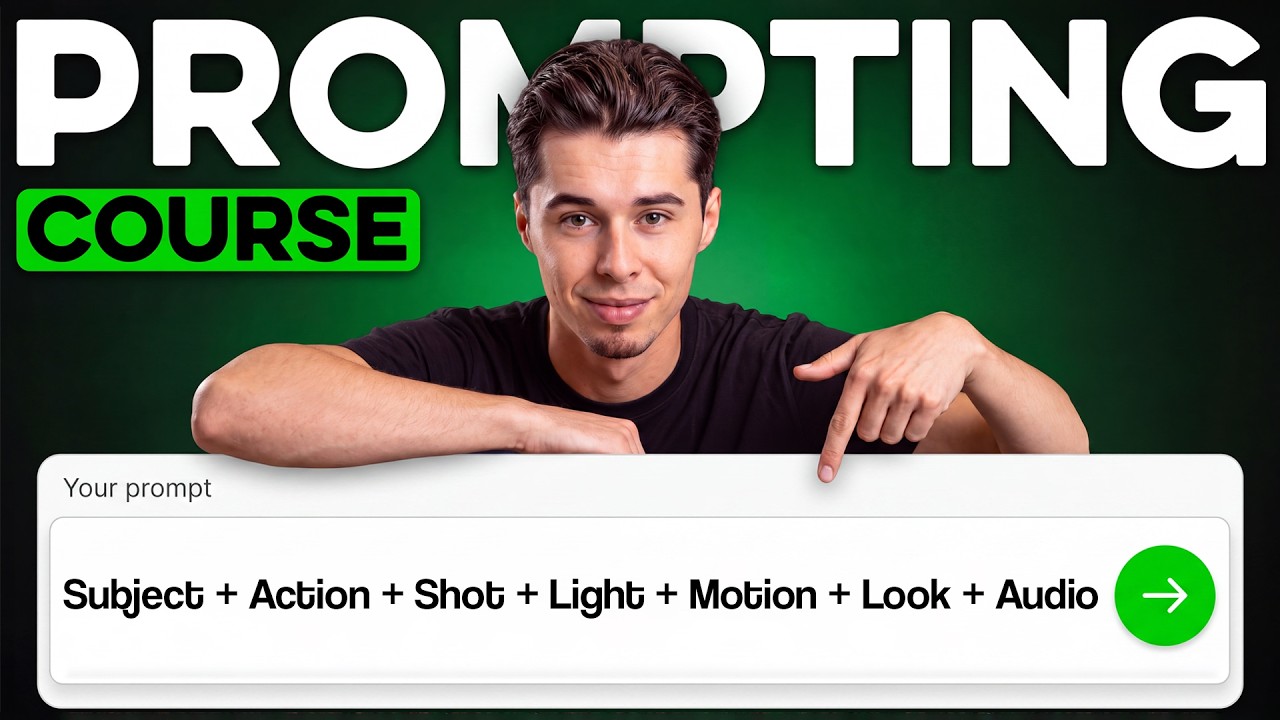
What this lesson covers
This video breaks down AI video prompting into a progressive five-level framework to move creators from unpredictable text prompts to precise cinematic control. Using Higgsfield and Seedance 2.0, Youri van Hofwegen illustrates how defining subject details, camera positioning, lens choice, and granular action sequences eliminates randomized outputs.
Key takeaways from the creator
AI-extracted notes, not independently verified product claims. Timestamp links let you check each point in the original video.
- 01:16 ↗
Single-sentence prompts delegate full creative control to the generator, causing randomized camera angles, character variations, and wasted credits.
- 03:52 ↗
Structuring Level 2 prompts around subject, action, setting, lighting, and shown mood yields predictable subject framing across renders.
- 04:27 ↗
Conveying emotional tone through physical action and environmental cues rather than abstract adjectives forces the AI model to render tangible atmosphere.
- 06:28 ↗
Detailing granular step-by-step physical interactions restricts the model's choices and maintains action consistency across multi-run generations.
- 07:07 ↗
Specifying camera parameters—including shot type, angle, movement, and focal length—locks the composition into a single continuous take.
Workflow outlined in the video
- Avoid vague one-line prompts when drafting shot concepts to prevent credit loss and unpredictable renders.
- Draft Level 2 prompts by explicitly detailing the subject, action, setting, key lighting sources, and physical indicators of mood.
- Replace abstract emotional labels with observable physical actions and environmental details.
- Define camera specifications including shot framing, camera height, motion trajectory, and lens focal length to maintain visual continuity.
- Test multi-pass renders with strict sequential action descriptions to evaluate visual stability before final output.
Before you use this workflow
These notes describe the source video at its publication date. Model access, pricing, connectors and interfaces may have changed. Check the original source and the provider’s current documentation before installing an add-on, connecting an account or spending credits.
ReelStack has not independently tested this workflow. Preview one representative shot and check motion, continuity and output quality before applying it to a full production. No result, cost saving or model capability is guaranteed.
Explore the tools
How to interpret the numbers
39,608 views captured 27 September 2026. ReelStack recommendation score: 31/100. Formula: radar-v5. This is ReelStack’s calculation, not a YouTube rating or a measure of factual accuracy.
Show the calculation
- 45% performance: 0.64× views vs 8 other channel videos observed at a similar age. View-evidence factor 98% (views / (views + 1,000))
- 25% freshness: 8/100 with a 14-day half-life
- 20% momentum: 546 views/day vs 399 channel baseline (6 comparable uploads), with the same view-evidence factor
- 10% engagement: 4/100; likes + 4× comments, smoothed with a 500-view neutral prior